
Fat Loss
Weight Loss Plateau: Why the Scale Stops Moving and What to Change
Four weeks of effort and the scale has not budged. Most of the time that is not a broken metabolism, it is a measurement problem. Here is how we work out which one you have.
Fat Loss
By Brad Ellison ·
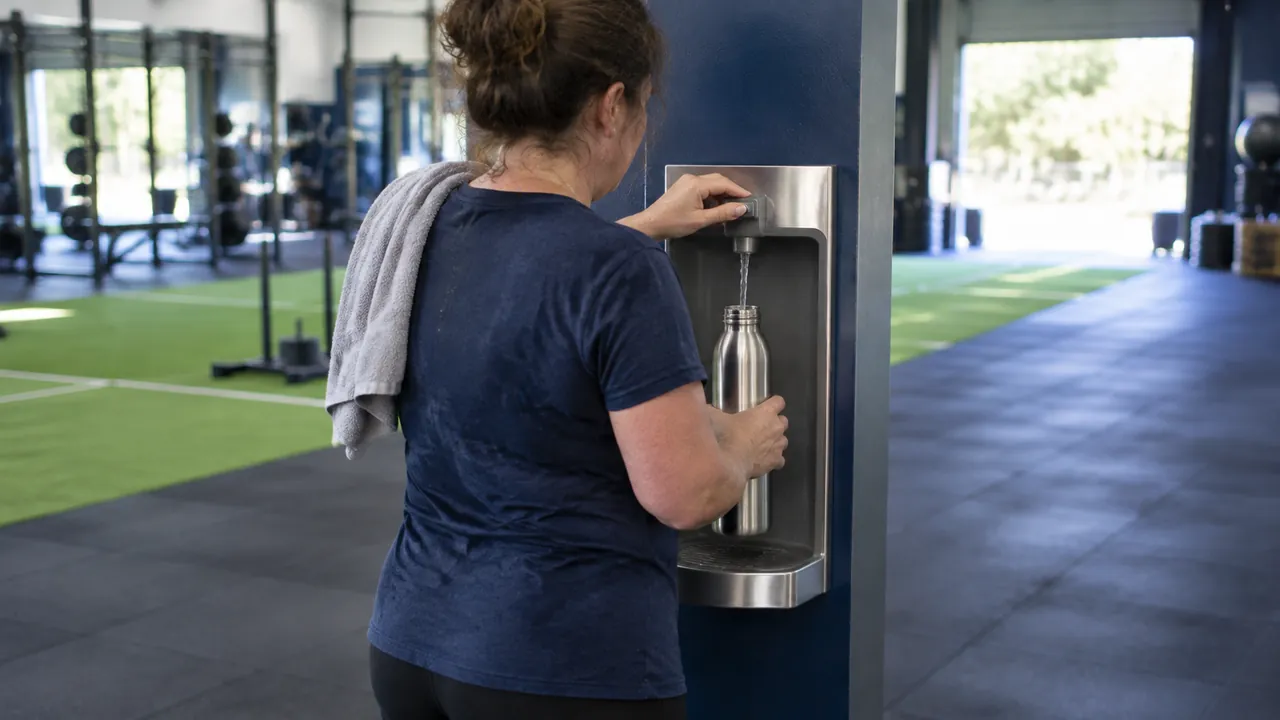
A 1 to 2kg swing on the scale inside a day or two is almost always fluid, not fat, and it happens more in a Sydney summer because you sweat more, drink differently and eat saltier food. Sports Dietitians Australia puts it plainly: weight loss during exercise is primarily water loss, not fat loss. So the number that frightens you on Tuesday morning after a hot Monday session, and the number that is back up 1.5kg on Thursday, are both reports on your hydration rather than on your progress.
Since 2011 I have watched more people walk away from a program over a bad weigh-in than over a bad training block, and almost every one of those weigh-ins was water. This is the article I wish every new member read in their first fortnight, because getting this wrong in December is what turns a good six weeks into a write-off.
Body weight is not a measure of fat. It is the total of everything you are carrying at that moment, and most of that total moves around on a daily cycle. Better Health Channel gives the conversion that makes this concrete: one litre of water is equivalent to one kilogram. So every litre of sweat you leave on the gym floor shows up as a kilogram gone, and every litre you drink back shows up as a kilogram returned.
Four things move the number day to day, and none of them are fat:
This is the arithmetic that settles it. Better Health Channel describes a reasonable rate of loss as about half a kilo to one kilo per week, and that is the rate most likely to be maintained. So 2kg of genuine fat takes somewhere between two and four weeks of consistent work.
If the scale moves 2kg between Monday and Wednesday, it is not fat, in either direction. You did not lose two weeks of progress overnight and you did not undo it with one dinner. Nothing in human physiology moves fat that fast. Once you accept that, the daily number stops being a verdict and becomes what it actually is, which is noise with a slow signal buried in it. We go through what a real stall looks like, as opposed to a bad weigh-in, in why your weight loss has plateaued.
Heat changes the size of the swings, and it changes them in the direction that fools people. You sweat more in every session, so the post-training number drops further. You drink more across the day, so the morning number climbs further. The amplitude goes up while the actual rate of fat loss stays the same, and a bigger swing around the same trend feels like chaos.
Here is the part worth taking seriously, because it reframes a 1.5kg drop from a win into a warning. Better Health Channel notes that a loss of fluid equal to two percent of body mass, which is a 1.4kg loss in a 70kg person, is enough to cause a detectable decrease in performance. So if you walk off the gym floor 1.4kg lighter in February, that is not progress, it is a reason your next session will be worse. Dehydration also raises the risk of heat-related problems, which in a Sydney summer is not a theoretical concern (Better Health Channel).
Then there is the December layer on top of the heat. Functions, long lunches, drinks, irregular meal times and a fortnight away from your normal week. All of that moves fluid and food weight around without necessarily moving your body composition much at all. What it does move is your confidence, which is the thing that actually decides whether you are still training in February.
If you are going to use a scale, use it properly. Better Health Channel's own guidance on measuring fluid loss is to weigh yourself in minimal clothing, as close to the start of exercise as possible, which tells you something useful about method generally. Standardise everything you can, then only compare like with like.
What we tell people at the studio is that the scale is one input of four, and it is the least informative of the four. These are the others, in the order I would trust them.
Better Health Channel is direct about this: do not rely on the numbers on the scales, measure your waist circumference instead. It names a healthy waist as less than 94cm for men and less than 80cm for women. A tape measure costs a few dollars, it does not care about your hydration, and it tracks the fat that actually matters for health. Measure it once a fortnight at the same point, first thing in the morning.
This is the one that ends the argument, because it answers the only question that counts: of the weight that moved, how much was fat, how much was muscle, and how much was water. Better Health Channel warns that when you lose weight too quickly you lose fat and muscle together, and a bathroom scale cannot tell you which happened. Our InBody 570 splits body weight into fat mass, lean mass and body water, which means a month of apparent nothing on the scale often turns out to be 2kg of fat down and 2kg of muscle up. We explain how to read one properly in our guide to InBody body composition scanning, and the scan itself is on the InBody scan page.
Attendance and load are the only two numbers you fully control, and they lead the body-composition numbers by weeks. If your sessions completed are up and the weight on the bar is up, the composition change is coming whether or not the scale has noticed yet. If attendance is down, no amount of weighing will fix it.
Better Health Channel lists these as motivation measures and they are better evidence than most people give them credit for: how your clothes fit, whether you have more energy, whether you are sleeping better, and whether you can now do something you had been avoiding. Those four shift well before a stubborn scale does.
If you want the swings to settle down, fix the hydration rather than the scale. Both Better Health Channel and Sports Dietitians Australia land in the same place: replace around 125 to 150 percent of the fluid you lost, and spread it over the next two to six hours rather than drinking it all at once. On a hot day, get some salt back in with it, because sweat takes sodium with it and water alone does not replace that.
Worth saying out loud: doing this correctly makes the scale go up. That is the right outcome. You are putting back what you are supposed to have. A rehydrated person who weighs 1kg more than they did at the end of the session is in better shape to train tomorrow than a dehydrated person celebrating a number. For how heat and cold fit around training through summer, including when the sauna helps and when the ice bath is the wrong call, see our guide to the infrared sauna and ice bath in Maroubra.
Practically, this is the system: a scan at the start so we know the real starting point, daily weigh-ins used only as a weekly average, a waist measurement every fortnight, and a scan again at the end of the block. Nothing in the plan changes on a single reading. What we have seen first hand since 2011 is that the people who measure less often and more deliberately stick around longer than the people who weigh themselves twice a day, and sticking around is the entire mechanism of fat loss.
If you want the realistic timeline against which to judge all of this, rather than a number from a magazine, we work it through in how long it takes to lose 10kg. The short version is that the weeks do the work and the scale just reports on them, badly, in summer.
Questions
Fat Loss
Four weeks of effort and the scale has not budged. Most of the time that is not a broken metabolism, it is a measurement problem. Here is how we work out which one you have.
Body Composition
What an InBody 570 scan measures, how accurate it really is versus DEXA, how to read your result, and where to book one in Maroubra, from a studio that scans members every 4 to 6 weeks.

Fat Loss
Between 10 and 20 weeks at a sustainable rate, and about 14 if you want to keep it off. Here is what sets your timeline.
Recovery
There is an infrared sauna and ice bath in Maroubra at our Malabar Road studio. Here is how hot it runs, how long to sit in it, how to pair heat with cold, and how to book.
This article is general information for healthy adults and is not medical, dietetic or physiotherapy advice. Speak with your GP or a qualified health professional before starting a new exercise, nutrition or recovery program, particularly if you have an existing injury or medical condition.
Your next step
The 28-Day Kickstart includes a consultation, an InBody scan and four weeks of coached training.