
Fat Loss
Menopause and Weight Gain: What Actually Works After 45
Why the weight settles around your middle after 45, and what actually shifts it.
Training
By Brad Ellison · · Updated 18 September 2026
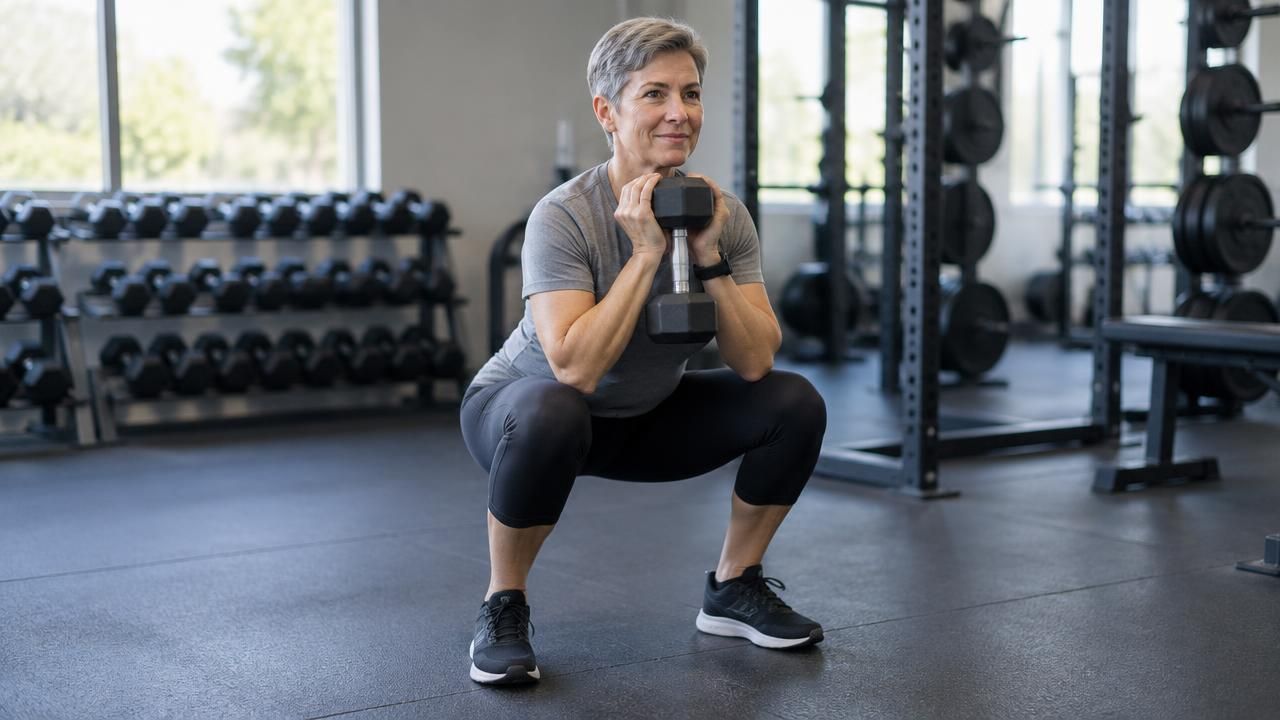
For women over 50, strength training is one of the highest-value habits available: it protects bone density, holds on to the muscle that ageing and menopause take away, and keeps you strong and independent. It is safe to start at any age, and the first 12 weeks usually change more than women expect.
The years around menopause bring a drop in oestrogen that accelerates bone loss, alongside an age-related decline in muscle and a shift of fat towards the middle. The Australasian Menopause Society describes the change as more fat and less muscle, frequently with no net change in body weight, which is why the mirror and the scale tell different stories. We unpack that in detail in our guide to menopause and weight gain.
Resistance training is the most direct countermeasure to both problems. In a meta-analysis of 101 randomised trials in 5,697 postmenopausal women, resistance and combined training were the modes that increased lean mass, with an overall gain of about 0.66kg of fat-free mass. Aerobic work was better for stripping fat. You want both, and most women get there on three to four sessions a week.
The LIFTMOR trial out of Griffith University put postmenopausal women with osteopenia and osteoporosis through twice-weekly supervised high-intensity resistance and impact training for eight months. Bone mineral density at the spine and hip improved, as did height and functional performance, with high adherence and without the injuries everyone assumes. The key word is supervised. Heavy lifting works for bone precisely because it is heavy, which is also why technique and coaching are not optional.
The practical test we use at 6X: on your last repetition you should have about two reps left in the tank, and no more. For most women that lands somewhere between 6 and 12 reps per set. If you finish a set and could comfortably do another eight, the weight is not doing anything for your muscle or your bones. If your technique falls apart, it is too heavy. A coach closes that gap in a session or two.
In my experience the sequence is predictable. Weeks one to three: coordination and confidence, and the weights start moving up quickly because the nervous system adapts before the muscle does. Weeks four to eight: strength numbers climb noticeably, everyday tasks get easier, and clothes start fitting differently. Weeks eight to twelve: body composition changes usually show up clearly on a scan, which is why we reassess monthly instead of weighing daily. Since 2011 we have watched that same pattern play out with hundreds of women, and the ones who stay past week four almost always stay past week twelve.
This is the most common worry and it is unfounded. Women have lower testosterone and do not build large muscle easily. What strength training actually produces is a leaner, stronger, more capable body and better bone health. If you want to see whether a change came from fat or from muscle, an InBody scan separates the two rather than leaving you to guess.
It is mid-September. NSW school holidays run from 28 September to 9 October and Term 4 starts on 13 October, so the next few weeks are the last quiet run before the year accelerates into December. Twelve weeks from this week is the second week of December, which is exactly long enough for the changes above to show up. A free consultation and a baseline scan take about 45 minutes and give you a starting point you can measure against.
If you are weighing up where to train, our guide to choosing a gym in Maroubra you will actually keep using covers the questions worth asking before you sign anything.
Questions
Fat Loss
Why the weight settles around your middle after 45, and what actually shifts it.
Training
Why resistance training becomes the highest-value habit after 40, and how to start safely.

Body Composition
What an InBody 570 scan measures, how accurate it really is versus DEXA, how to read your result, and where to book one in Maroubra, from a studio that scans members every 4 to 6 weeks.
This article is general information for healthy adults and is not medical, dietetic or physiotherapy advice. Speak with your GP or a qualified health professional before starting a new exercise, nutrition or recovery program, particularly if you have an existing injury or medical condition.
Your next step
A short conversation about your goals, your history and what a realistic plan looks like.